Optimize the Loyalty Breakage Rate [KPI]

[Part of the KPI and insight framework: “Loyalty Best Practices [KPI]” for Actionable Insight]

Loyalty point breakage measures the percentage of all issued loyalty points (or their value) that expire before they are redeemed. This metric is used to assess financial liability related to the value of unredeemed points; however, it is also an important metric to estimate the engagement of the loyalty program since it is the inverse calculation of redemption rate.

A high level of loyalty point breakage indicates a low level of engagement by members with the program and a mismatch between the rewards offered and members preferences. This excessive breakage can undermine the program's purpose and negatively affect its value for both members and the brand. High point breakage rates signal declining member engagement and signify the program's decreased effectiveness.

Example of benefits: 

  • Member interest and engagements: Keep the members engaged and ensure they redeem and engage with the brand
  • Member spending: With the right rewards and thresholds to drive engagement and redemption the spending of your members will increase.

Concept

Improve you members engagement and spending by optimizing the loyalty breakage rate by a set of actionable loyalty tactics. Understand if and when your loyalty program reward structure is causing lower engagement levels and how this also impacts the redemption rate.

Execution Overview

  1. Define and understand loyalty program breakage and redemption rate and how to interpret them
  2. Calculate loyalty breakage rate
  3. Use appropriate benchmarks and customer segmentation
  4. List out possible loyalty actions that can be employed and prioritize
  5. Implement the loyalty actions in your loyalty platform

KPI

  • Improve Loyalty Breakage Rate - 10 basis points
  • Improve member sales - 5%

Detailed Execution Plan (Steps)

Since this is a KPI related best practice focus will be on understanding the metric, providing benchmarks that are appropriately segmented and insights to loyalty actions that can be taken.

#1

Definition and Formula

The loyalty breakage rate is a financial and engagement metric that measures the percentage of all issued loyalty points (or their value) that expire.

There are two views of this KPI:

  • Finance/Accounting perspective: Points represent a liability on the company's balance sheet. When points expire, that liability is "broken" and is recognized directly as revenue (or a reduction in liability)
  • Loyalty/Marketing perspective: A high breakage rate is a critical failure. It signifies that the program is not engaging, the rewards are unattainable or undesirable, or the communication is poor.

The goal is not to achieve 0% breakage but to find an optimal rate that signals strong engagement while remaining financially sustainable (not giving away large discounts).

There are two primary methods for calculating breakage, one based on a specific period and the other based on a set of customers.

A. Periodic Breakage Rate (Operational KPI)

This is the most common way to track breakage as an ongoing operational metric. It measures what percentage of all points removed from circulation during a period was due to expiration versus redemption.

Periodic Breakage Rate = Value of Points Expired in Period \ (Value of Points Redeemed in Period + Value of Points Expired in Period)


B. Customer Set Breakage Rate (True Liability Model)

This is the financial definition used for accounting; it tracks a specific batch of issued points from creation to their final expiration date.

Customer Set Breakage Rate = Total Points Expired (from Customer Set) / (Total Points Issued (to Customer Set)


Do note that redemption rate is the inverse of loyalty breakage rate. For any pool of points that has finished its life (meaning it has either been redeemed or it has expired), the relationship is:

Periodic Redemption Rate + Breakage Rate = 100%


Do note that there are different formulas that can be used for redemption rate but for consistency will use the periodic redemption rate.

Calculate loyalty breakage rate

For this example, we will calculate the periodic breakage rate (Operational KPI). You will typically have detailed point balance reports available in the loyalty platform. Within Memberson Loyalty CRM platform there is a standard point balance history report with the following fields:

So, the calculation using these fields would be:

Periodic Breakage Rate = Value of Points Expired in Period / (Value of Points Redeemed in Period + Value of Points Expired in Period)

=>

Periodic Breakage Rate = Expired / (-PointUsed-PointUsedAdjustment+Expired)

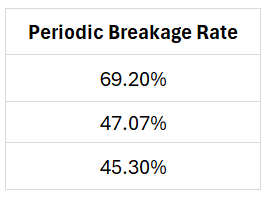
which will result in these sets of loyalty breakage rates:

The next step is to analyze these numbers to understand what type of actions that you may need to take to improve these metrics.

Benchmarks & Segmentation

At this point having helpful and detailed benchmarks may help in the interpretation and discussion with senior management. However, as with any figures, it is the local context and circumstances that are important rather than generic benchmarks. If you are going to use benchmarks, they need to be broken down to a level that makes some sort of comparison possible.

Let’s first look at a higher level first.

QSR – Quick Service Restaurant

There are a lot of details that get lost in these blended rates and it is paramount to look at this from a much more detailed benchmark perspective.

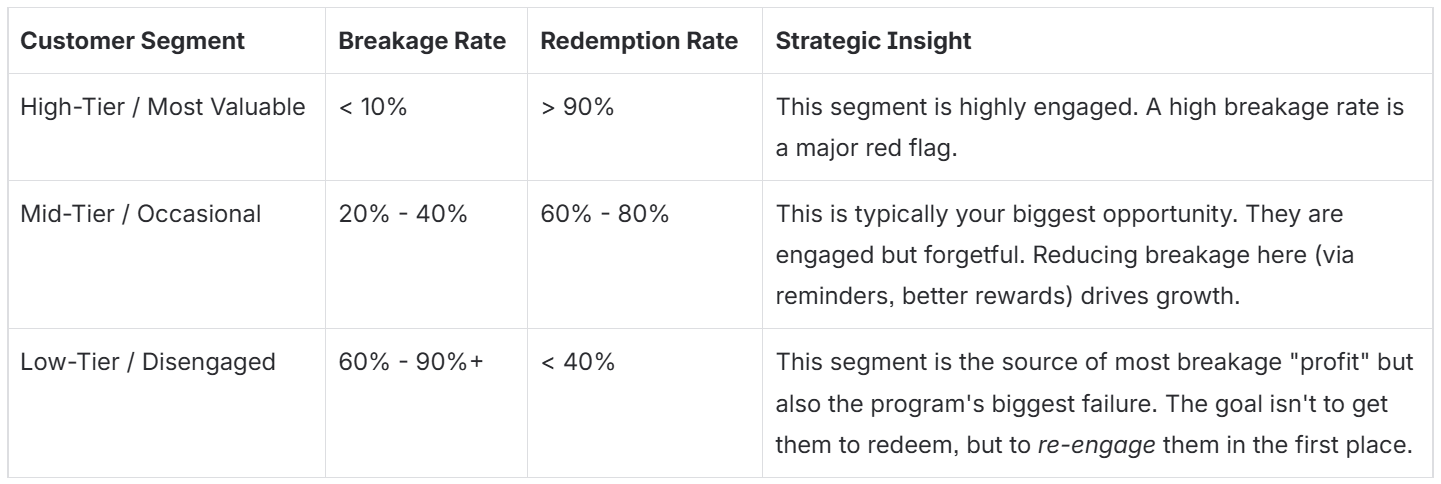
However, these benchmarks although broken down further only give an indication, further analysis should be done by customer segments. If we look at specific customer segment benchmarks you may be expecting to see these types of details. Please note that the below is blended rates, hence for a low-frequency purchase business these can be expected to be much lower (redemption rate).

Loyalty Actions

The loyalty actions that is relevant to you will depend on your loyalty program, membership base, industry and similar. However, there are a set of common loyalty actions that you can start reviewing and prioritizing.

We will assume that to "improve" this KPI means to decrease it (increase redemption rate) by encouraging engagement, thereby proving the program's value. The below 4 items are based on our experience often the most impactful and if not already in place you may want to consider them

  1. Implement Proactive Expiration Warnings: This is one of the most direct and effective action. Send automated, multi-step email, SMS and push notifications (e.g., 90-day, 30-day, and 7-day warnings) that clearly state, "You have X points expiring on [Date].” And what rewards that may be available.
  2. Lower Redemption Thresholds: High breakage is often caused by rewards that feel impossible to reach. Introduce smaller, more accessible rewards to give mid- and low-tier members a way to redeem.
  3. Make sure the redemption are stackable: A common mistake is that the you are running large discounts separate from the membership, and then not allowing stackable discounts. This typically causes very high breakage ratios and diminishes the value of the membership program. This is typically not a good strategy if you are interested in building a successful loyalty program.
  4. Recommend "Just-for-You" Rewards: Don't wait for members to browse a catalogue. Proactively push recommendations based on their point balance. A message like, "You have 500 points. Redeem them now for a free [Product]" is far more effective than a simple balance update.


There are many other actions that may make sense for your loyalty program as well. The list below is compiled to give you more ideas on what you potentially could do.

  • Tiered Reward Catalog: Offer a mix of reward types of values and what they give
  • Personalized Reward Recommendations: Use member data to suggest the most relevant reward they currently qualify for.
  • Gamified reminders: You're only 50 points away from your next reward!
  • Change Expiration Policy: rolling point expiry, ensure value, reward and expiry matches.
  • Implement Points + Pay: Allow members to use the points they do have to cover a portion of a purchase.
  • Introduce Non-Monetary Rewards: Offer rewards that have a high perceived value but a low hard cost, such as: Early access to sales, Free shipping upgrades., Access to exclusive (digital) content
  • Offer "Earn-on-Burn" Promotions: Run a campaign where members get bonus points for their next purchase after they make a redemption. This links the reward (redemption) to the next behavior (purchase)
  • Create "Short-Expiry" Bonus Points: When running a "2x Points" promotion, make the bonus portion of the points expire very quickly (e.g., 30-60 days). This creates strong, immediate urgency to redeem without affecting your core program liability.
  • Give New Members a "Head Start": Use the "Endowed Progress Effect." Give new members a small number of "welcome points" (e.g., 100 points when a reward is 1,000). This makes the first reward feel more attainable and psychologically invests them in the program.
  • Offer a "Points Rebate" on Redemptions: When a member redeems 1,000 points, give them 50 or 100 points back. This "reward for redeeming" reinforces the behavior and makes it feel even more valuable.
  • Tier-Based Redemption Discounts: Reward your best members for being good members. Offer your Gold and Platinum tiers a permanent discount on all redemptions (e.g., "Get a $10 reward for 800 points instead of the standard 1,000"). This reinforces their status and ensures they redeem.
  • Run a "Points Amnesty" Day: As a last resort before a mass expiration, announce a 24-hour "Amnesty Day" where members can "save" their expiring points by redeeming a very small "save my points" reward or by making any purchase.
  • Expand Reward Partnerships: Allow members to redeem points with other relevant brands, increasing the utility and appeal of the points.
  • Balance-on-Receipt: Print the member's point balance and its approximate cash value (e.g., "You have 1,200 points—that's $12 off!") on every physical and digital receipt.
  • Enable Automatic Redemption: Automatically issue a reward voucher (e.g., "$5 off") via email or to their account as soon as a member reaches a specific threshold, removing the need for them to "claim" it.
  • Prompt at Point-of-Sale (POS): Train cashiers or use the payment terminal to prompt the customer: "You have 1,500 points, which is $5 off. Would you like to use it now?"
  • Allow Point Gifting/Transfer: Let members send their points to a friend or family member. This clears the liability and acts as a form of brand advocacy.
  • Offer Charitable Donations: Allow members to redeem their points by donating the cash value to a charity. This is an excellent low-cost option for members who aren't motivated by discounts.
  • Create "Sweepstakes" Redemptions:  Allow members to use a small number of points (e.g., 50 points) to enter a raffle for a large prize. This helps "mop up" small, unused point balances.
  • Run "Flash Redemption" Events: Create urgency by launching short-term events (e.g., "This weekend only! Redeem any reward for 20% fewer points").
  • Implement "Surprise & Delight" Redemptions: For members with points nearing expiration, proactively send them a small, fully-redeemed reward (like "Free Shipping" or a "$5 Off" code) to re-engage them.
  • Integrate "One-Click" Redemption: On your website, add a "Use 1,000 Points" button directly in the shopping cart to make redemption seamless.

Implement the loyalty actions

As you would have realised these can easily be implemented in the Memberson CRM loyalty platform with standard functionality. There are even separate loyalty best practices that further describes how to implement some of these loyalty actions such as (this is not an exhaustive list):

  • #2 Smart Partner Rewards: Expanding Member Value, Reduce Cost
  • #6 Loyalty Best Practice - Intelligent Point Balance Thresholds to Drive Behavior
  • #8 Deep links for higher voucher conversion
  • #12 Increase spending through stepped rewards
  • #16 Shorten repurchase time with timed vouchers
  • #29 Intelligent reactivation of members
  • #30 You are almost there – Tier promo
  • #31 Use point expiry as a sales opportunity

Do please reach out to us if you need help to better understand loyalty breakage ratio and how to improve it.

Loyalty Best Practices

Our Loyalty Best Practices consist of executable loyalty practices to drive specific KPIs of the loyalty program. The loyalty best practice database contains many different types of practices that you can use to deliver the right results for you. Please let us know if you are interested in receiving information about other loyalty best practices or have a more in-depth discussion on how the above loyalty best practice can be utilized in your organisation.

Thank you! Your submission has been received!
Oops! Something went wrong while submitting the form.